🖊️ Written by Marcus Reyes
Updated 4 months ago
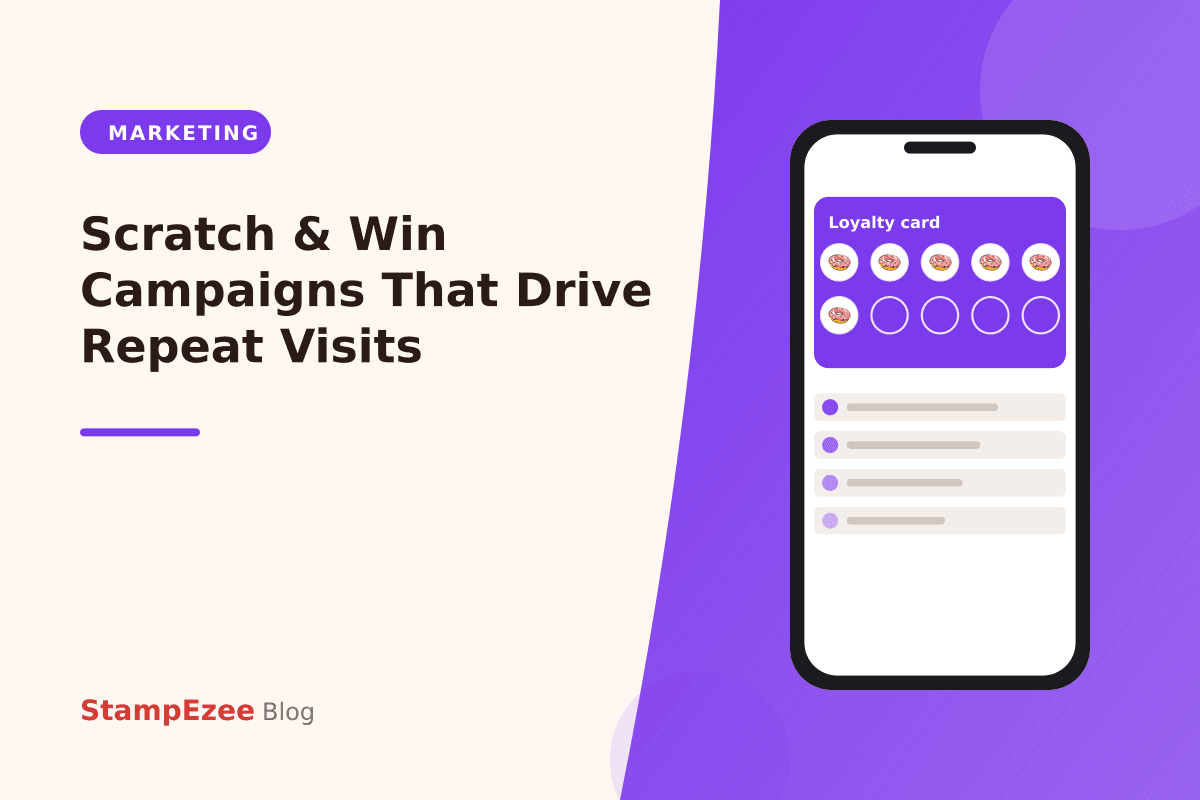
A Scratch & Win campaign sends customers a digital scratch card straight to their phone, delivered by push notification, email, or WhatsApp, and reveals a reward the instant they scratch it. Because StampEzee cards live in the customer's wallet alongside their stamp and point cards, the surprise feels personal rather than generic.
Used well, scratch campaigns turn an ordinary reminder into a reason to walk back through the door within days, not weeks.
A Scratch & Win campaign is a short, gamified moment built into the StampEzee customer app. The retailer sets up a batch of digital scratch cards, each hiding a reward behind a scratch-off layer, and sends them out to a chosen audience by push notification, email, or WhatsApp. When a customer taps to scratch, the card reveals what they have won on the spot.
Rewards can be anything the retailer decides: a free item, bonus stamps, a percentage off, or simply "try again next time." Because the card sits inside the same app as the customer's stamp and point cards, claiming a prize feels like part of the loyalty experience rather than a separate promotion.
A flat 10% off code is predictable, and predictable offers are easy to ignore. A scratch card works differently: the customer does not know what is behind the scratch-off layer until they play, and that small moment of uncertainty is what pulls them back in. Behavioural marketers call this a variable reward, and it is the same mechanic that makes games and daily check-ins so sticky.
The reward itself does not need to be large. A modest surprise delivered through play often drives more repeat visits than a bigger discount delivered as plain text, simply because customers remember how it felt to open it.
Timing turns a fun feature into a real repeat-visit driver. A few dependable moments to trigger a scratch card:
Because these triggers can be scheduled or automated, a retailer does not need to remember to launch a campaign manually every time.
Not every scratch card needs to reveal a prize. Retailers can set the odds so that only a portion of cards win a reward, similar to setting probabilities on a prize wheel, which keeps the campaign both exciting and affordable. A mix of a few high-value prizes, several small ones, and a friendly "better luck next time" message keeps the cost predictable while the experience stays fun.
It helps to treat the reward pool the way a retailer treats any promotion: know the cost per redemption in advance, decide on a budget for the campaign period, and adjust the mix if redemptions run higher or lower than expected.
The StampEzee analytics dashboard shows how many scratch cards were sent, opened, and redeemed, alongside the repeat-visit rate for customers who received one. Comparing that rate against a similar group who did not receive a scratch card is the clearest way to see whether the campaign is actually bringing people back sooner.
Per-branch reporting also shows whether a scratch campaign performs differently at one location than another, which is useful when deciding where to run the next one and how generous the reward mix should be. That comparison is what separates real repeat-visit growth from a coincidence, giving retailers the confidence to run the next campaign with an even sharper reward mix.
Was this article helpful?

Contact Us
Still have questions?
If you have questions about setup, loyalty flows, pricing, or roles, our team is here to help you understand how StampEzee fits your business before you launch.